D7 Visa Portugal for Americans: Requirements & Process 2026
If you’re researching the D7 Visa for Portugal, you’ve probably already found plenty of articles telling you that you need €920 per month — plus 50% for your spouse and 30% for each child.
There’s a problem with that explanation.
It mixes up two different things: the income that qualifies you for the D7 route and your household’s means of subsistence.
They’re not the same thing.
And when you’re preparing an actual D7 application, that distinction matters.
So let’s start there.
1. What is the Portugal D7 Visa?
The D7 is a Portuguese residence visa commonly used by retirees and people who live from their own regular income.
It is often called Portugal’s “retirement visa”, but there is no requirement to be retired or to have reached retirement age.
What matters is the nature of the income supporting your application.
For Americans, the D7 may be appropriate when the main applicant can demonstrate qualifying passive income sufficient to support the application.
The residence visa is applied for while you are still in the United States. Once approved, it allows you to travel to Portugal and continue your residence process here.
Your D7 Visa is not your Portuguese residence permit.
2. What actually counts as passive income for a D7?
This is the first thing we establish with a client before doing anything else.
Usually compatible with a D7
Pension
US Social Security retirement income
Rental income
Dividends
Interest
Other qualifying income from assets or investments
Not passive income
Salary from remote employment
Freelance income
Consulting income from active work
Active professional or business income
Portugal Wizard Watch Out The amount you earn does not determine whether income is passive. The source of that income does.
If you earn $8,000 per month working remotely for an American company, that does not become passive income because you can perform your job from Portugal.
Likewise, freelance income remains active professional income.
If your relocation is supported by remote employment or freelance income from outside Portugal, you should be looking at the D8 Digital Nomad route rather than trying to fit active income into a D7 application.
3. How much passive income does the main applicant need in 2026?
For the main D7 applicant, we work with a minimum qualifying passive income equivalent to the Portuguese minimum wage.
In 2026, that means €920 per month, or €11,040 per year.
But this is where many D7 guides start making things unnecessarily confusing.
You’ll often see €920 for the main applicant, €460 for a spouse and €276 for a child described as a household “passive income” requirement.
That is not how we interpret or prepare the financial requirements.
The 100% / 50% / 30% calculation comes from Portugal’s rules on means of subsistence for the household. That is a separate concept.
4. Passive income and means of subsistence are not the same requirement
This is probably the most important section of this guide.
For a D7 application, we look at two separate financial elements:
Qualifying passive income
The main applicant demonstrates the qualifying passive income supporting the D7 route.
For 2026, we work with a minimum of €920 per month.
This income should be evidenced where it actually exists. If your pension is paid into your US bank account, that is where we expect to see its history. If you receive rental income, we want to see the appropriate evidence of that income.
You do not need to redirect your passive income into your Portuguese bank account.
Means of subsistence for the household
Portugal Wizard Watch Out Don’t confuse “I receive at least €920 per month in qualifying passive income” with “I have the required 12 months of means of subsistence available in Portugal.”
They are two different parts of the financial preparation. And no, your spouse does not suddenly need to create a €460 monthly pension just because they’re accompanying you to Portugal.
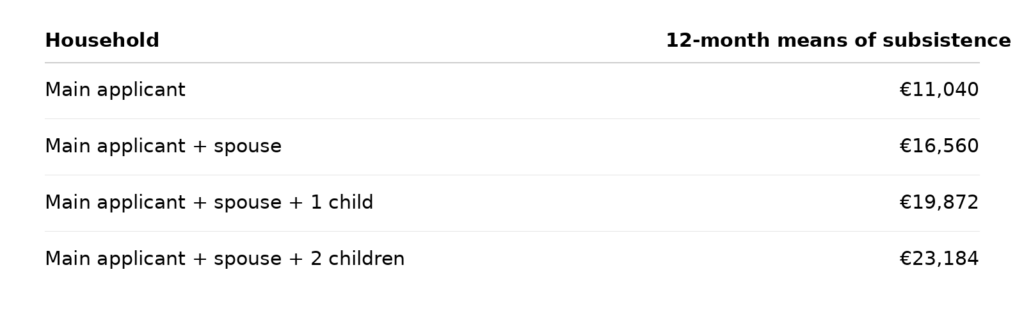
Separately, Portuguese law establishes the means of subsistence required for the household using the following calculation:
First adult: 100%
Additional adult: 50%
Each child/dependent: 30%
For a residence visa, those means must be assured for a period of at least 12 months.
For 2026:
For D7 preparation, these are the amounts we want available in the Portuguese bank account before the visa application is submitted.
5. Does your passive income have to be paid into Portugal?
No.
Your passive income should be demonstrated through its actual source and payment history. If you receive US Social Security into an American account, we want to see that. If you receive a pension, we want evidence of the pension and its payments. If you receive rental income, the evidence should support that income.
The Portuguese bank account serves a different purpose in the preparation: it allows you to demonstrate the funds available in Portugal for the household’s means of subsistence.
Portugal Wizard Watch Out Don’t move your pension or other passive income to Portugal simply because somebody told you that the D7 requires your income to be paid into a Portuguese bank account.
The income and the funds available in Portugal should not be confused.
Imagine you receive $1,500 every month from an annuity. That’s above €920. Does that automatically mean you have a strong D7 income case? Not necessarily.
We also want to understand how long you have been receiving it, how frequently it is paid, how long it will continue, where it is paid, what documentation proves the income, and whether the income is sustainable in the context of establishing residence in Portugal.
An annuity continuing indefinitely presents a very different picture from an annuity scheduled to terminate relatively soon after your application.
Portugal Wizard Watch Out A recurring payment is not necessarily the same thing as sustainable passive income.
Don’t assess a D7 case from the monthly amount alone.
7. What about savings?
Savings and passive income shouldn’t be treated as interchangeable concepts either.
Having substantial savings can strengthen your overall financial position and is relevant to demonstrating your means of subsistence. But if you have no qualifying passive income at all, don’t simply assume that a large savings account automatically converts your situation into a standard D7 case.
This is exactly the sort of question that should be resolved before you start preparing documents, opening accounts or signing a lease in Portugal.
8. What documents do Americans generally need for a D7 Visa?
The exact file depends on the applicant, but your preparation will generally include documentation relating to:
passport and identity;
qualifying passive income;
history and continuity of that income;
means of subsistence;
Portuguese banking;
accommodation in Portugal;
FBI criminal record and apostille;
appropriate insurance;
family relationships, where relevant; and
any additional evidence required by your circumstances.
But please don’t treat this as a shopping list. You don’t want to obtain every document at the same time.
Some can be prepared early. Others are time-sensitive. A properly planned D7 application is a sequence, not a race to collect paperwork.
9. When should you get your FBI background check and apostille?
Our practical recommendation is generally to request the FBI criminal record and apostille together, at the appropriate point in the preparation.
Don’t obtain your FBI record simply because you’ve decided that you want to move to Portugal and then leave it sitting in a folder for months while you work out everything else.
If too much time passes before submission, the safer approach may be to obtain fresh documents.
Portugal Wizard Watch Out Being early isn’t useful if your document is already old when you finally need it.
First plan the application. Then request the time-sensitive documents at the right point in that timeline.
10. When should you rent your home in Portugal?
Not first.
You’ve decided to move to Portugal, you’ve started looking at properties online and finding the home suddenly makes the whole move feel real.
But accommodation should generally be one of the later steps in your D7 preparation, while still leaving enough time before your visa submission.
Otherwise, you can end up paying rent in Portugal for months while you’re still waiting for the rest of your application to come together.
At the same time, don’t leave accommodation until the very last minute either. Visa appointment availability isn’t always predictable.
Portugal Wizard Watch Out Don’t let the excitement of finding a Portuguese home dictate your visa timeline.
Your application timeline should determine when it makes sense to secure accommodation.
11. How do Americans submit a D7 Visa application?
For applicants residing in the United States, Portuguese residence visa applications are currently submitted through VFS Global.
Applications must be submitted in person at the VFS Visa Application Centre corresponding to your jurisdiction.
VFS receives the application and supporting documentation. VFS does not decide whether your D7 is approved. The decision is made by the relevant Portuguese consular authorities.
Portugal Wizard Watch Out Don’t assume that the procedure somebody followed a year or two ago is still the procedure you’ll follow today.
VFS procedures, jurisdiction arrangements and appointment processes can change. Check the current rules when you’re actually preparing your application.
12. What happens when your D7 Visa is approved?
You can move to Portugal. But you’re not finished.
Residence Visa ≠ Residence Permit
Your D7 residence visa allows you to enter Portugal for the purpose of establishing residence. Your Portuguese residence process then continues with AIMA.
Portugal Wizard Watch Out Visa Approved is a milestone — not the finish line.
Moving to Portugal doesn’t end when somebody puts a visa in your passport.
13. What happens after you arrive in Portugal?
Depending on your circumstances, the next stages can include:
completing your AIMA residence process;
dealing with your Portuguese tax status and address;
accessing healthcare;
exchanging your driving licence where applicable;
arranging insurance;
setting up utilities;
dealing with schools if you’re moving with children; and
completing the other administrative steps involved in becoming established in Portugal.
This is why we distinguish between getting a Portuguese visa and relocating to Portugal. They’re not the same project.
14. D7 or D8: which one do you actually need?
Passive income → investigate D7
Active remote professional income → investigate D8
But real lives aren’t always that tidy. You might have a pension and continue working. You might receive dividends and also freelance. One spouse might be retired while the other still works remotely.
That’s why we look at the circumstances before recommending a residence route.
Don’t choose a visa because somebody in a Facebook group appears to have similar finances. Choose it because your circumstances actually fit the requirements.
There is no requirement to hire Portugal Wizard — or another relocation company — simply because you’re applying for a D7.
The more useful question is: Do you want to coordinate the entire relocation yourself?
Because the actual process involves much more than completing a visa form: the visa route, financial evidence, NIF, Portuguese banking, US documentation, apostilles, accommodation, timing, VFS submission and then the residence and practical stages after you arrive in Portugal.
Some people are perfectly happy managing all of that themselves. Others would rather have someone managing the sequence with them.
Portugal Wizard’s Pathway to Portugal is our personalised relocation assistance for people who don’t want their move to Portugal to become a second full-time job.
We don’t simply give you a D7 checklist.
We look at your circumstances, establish the appropriate route and coordinate the practical stages of your relocation — from preparation in the United States through your move and settlement in Portugal.
Because the difficult part usually isn’t knowing that you need documents, a NIF, a bank account and accommodation.
It’s knowing what applies to you, what to do next, and when to do it.
Planning a D7 move from the USA?
Tell us where you are in your relocation journey and we’ll help you understand what your next step should be.